Sunday, August 28, 2022

Skills we could keep or drop 1

 An article in MoneyWise discussed the skills we are losing and listed some of them the writer thought important that we keep. Over the next few posts, I will highlight some of the skills identified in the article and give my view on whether we should keep or lose the skill. I am interested in what do you think, so let me know in the comments.?

Back in the early days of the digital age, we talked about Digital natives, which were people who were born into a world where technology was already an integral part of daily life, and digital tourists or visitors, which were people who were only introduced to tech in their later years. For the record, I am a Digital tourist.

As computerization continues formerly essential skills like switchboard operation or being a human calculator have perished.

With any change comes loss, and more than a few life skills society used to take for granted are falling by the wayside. From ironing your clothes to the way we communicate, here are some skills that we should keep and some that can just go the way of the dinosaur.

1. Reading a map

In my youth, I once went on a Gymkhana. For those who don’t know, a gymkhana is a type of motorsport, known as Motorkhana in Australia and New Zealand and Autotesting in the United Kingdom and Ireland. Similar to autocross, the goal of gymkhana is to achieve the fastest time possible; memorizing the course is a significant part of achieving a fast time. But if you don’t memorize the course, you have a navigator who used a map to keep you on track. I was the navigator, and we became hopelessly lost and ended up not last but near the end.

Map reading was never my strong suit, but I think for those times when one is travelling, and Google Maps is not available this is a skill to keep.

In a survey commissioned by British mapping company Ordnance Survey, researchers found that only 20% of millennials wished they were better at reading maps. They probably should be though, because 60% of millennial respondents say they are reliant on digital maps when going somewhere new and a quarter are very reliant even in their day-to-day lives.

Google Maps and Waze are essential tools of 21st-century navigation, but there are countless stories of times GPS has failed travellers, causing them to be stranded in desolate locations. 

The first time I used Google Maps for directions in my car, we ended up on a mountain path that was a nightmare, and it took us about 4 hours out of our way, our problem was that the owner of the phone we were using had programmed the map wrong, but we believed in the technology when we should have read the map. There’s also the question of what happens if your phone runs out of battery, or you can’t access online maps. So I vote that we keep the skill of map reading and teach it to the yonger generation, just in case of emergency.

Saturday, August 27, 2022

The skill of estimation

Our grandchildren and our children are going back to school and I was thinking about when I had the opportunity to teach Math for a year. One of the skills I tried to teach was the skill of estimation. In our lives, we may not always need to be precise, so learning how to estimate is a good skill. I wish I had this website to refer to when I was teaching the skill of estimating. 

https://www.mathsisfun.com/measure/estimate-distance.html 

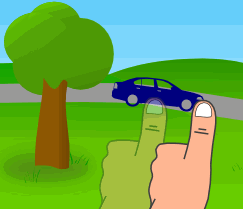
Here is an example of what they show students:

Here is a clever method to estimate how far away something is:

  • Hold your arm straight out, thumb up
  • Close one eye, align your thumb with a distant object
  • Switch eyes (don't move your thumb!)
  • Your thumb will seem to change position

Now ... estimate how far it moved sideways (you could imagine the length of a car or something).

Multiply that by 10 and you have an estimate of how far away.


thumb distance

Example

Here your thumb seems to jump about half a car length.

Half a car's length is about 2.5 metres.

Times 10: the car is about 25 metres away.

How it Works

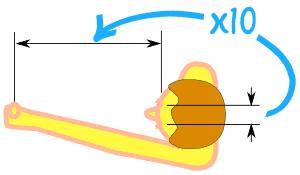
thumb distance is 10x eye distance

 The distance from your eyes to your thumb is about 10 times the distance between your eyes

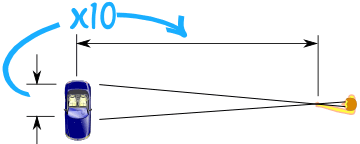
thumb distance far


And so the distance to the far object is also about 10 times the width your thumb seems to move at the far object.


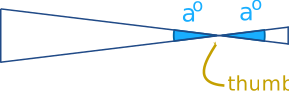
thumb distance similar angles

This works because the triangles are similar,
and so the relative lengths are the same.

Learn the Size of Things

To be useful you need to know how long, wide or tall things are!

  • Small cars are 4 m long
  • Large cars are 5 m long
  • Cars are about 1.8 m wide
  • Adults are about 1.8 m tall
  • A 5-year-old is about 1 m tall
  • A normal doorway is 2 m high and 0.8 m wide
  • A truck and trailer are about 20 m long
  • The width of a small house is about 8 m
  • The width of a large house is about 12 m
  • The height of a single-storey house is about 5 m
  • The height of a two-storey house is about 8 m
  • Tall buildings have about 3.5 m for every storey

(Note: to use this method for height, tilt your head and thumb 90° to the side.)

Friday, August 26, 2022

Senior Pension

 Interesting stats about seniors in Canada according to the government, proving that ageism exists and is practiced by the government.

Yesterday I said that I thought that the increase to the pension for seniors in Canada over 75 was unfair to those seniors under 75. 

In 2018, among OAS pensioners aged 75 and over, 59% had incomes below $30,000, compared to 52% of those aged 65 to 74.

In 2020, 39% of OAS pensioners aged 75 and over received the GIS, compared to 29% of those aged 65 to 74.

In 2020, among OAS pensioners aged 75 and over, 57% were women, compared to 52% among those aged 65 to 74.

These numbers show that seniors under 65 need the increase in pension just as much as those over 75. There is not a legitimate argument to not give these people an increase in their pensions. The only reason that I can see that there is no increase in pension is that the government is playing to institutional ageism to prevent an outcry against the policy. 

The government is seen to be helping one group of seniors so the general public will be happy and will ignore the fact that the government is ignoring the needs of another group of seniors. 


Thursday, August 25, 2022

Seniors get a raise

An increase to the Old Age Security pension for seniors aged 75 years and older begins next week, which I think is unfair to all those younger seniors between the ages of 65 and 75. We received our first increase last month and I must admit every increase helps. This raise will be the first permanent increase to the OAS pension since 1973, other than adjustments due to inflation. In 1970 Old Age Security benefits were $79 per month according to the Canadian Museum of History. So have these payments kept up with inflation? 

Yes, they have. According to the Inflation Calculator, $79 in 1970 is equivalent in purchasing power to about $589.80 today, an increase of $510.80 over 52 years.  Today’s OAS is about $668 for those under 75 and $773 for those over 75. So today as seniors we have slightly more buying power than the $79 that seniors had in 1973. The amounts may look more but it is always important to calculate buying power and adjust for inflation.

The dollar had an average inflation rate of 3.94% per year between 1970 and today, producing a cumulative price increase of 646.58%. This means that today's prices are 7.47 times higher than average prices since 1970, according to Statistics Canada's consumer price index. A dollar today only buys 13.394% of what it could buy back then.

The inflation rate in 1970 was 3.35%. The current inflation rate compared to last year is now 7.20%. If this number holds, $79 today will be equivalent in buying power to $84.69 next year. For example, if you started with $79, you would need to end with $589.80 in order to "adjust" for inflation (sometimes referred to as "beating inflation").

These numbers are important to remember when you are saving for retirement. If you don’t account for inflation your retirement may not be what you think it will be.

It is important for Canadians to remember that the objective of the OAS program is not to ensure an adequate pension but to ensure a minimum income for seniors and help reduce the incidence of low income among Canada’s seniors. The OAS benefits include the OAS pension, which is paid to all individuals aged 65 and older who meet the residence requirements; the GIS for low-income seniors; and the Allowances for low-income Canadians aged 60 to 64 who are the spouses or common-law partners of GIS recipients, or who are widowed or widowers.

The good news is that all OAS benefits are indexed, on a quarterly basis (in January, April, July and October), so that they maintain their value over time, even as prices increase. Increases to OAS benefits are calculated using the Consumer Price Index, which measures changes in prices paid by Canadian consumers for goods and services. In July 2022, as a result of quarterly indexation, maximum OAS benefits increased by 2.8%.