Thursday, February 14, 2013

Valentine’s Day

Age does not protect you from love. But love, to some extent, protects you from age. - Anais Nin

The history of Valentine's Day--and the story of its patron saint--is shrouded in mystery. We do know that February has long been celebrated as a month of romance, and that St. Valentine's Day, as we know it today, contains vestiges of both Christian and ancient Roman tradition.

The Catholic Church recognizes at least three different saints named Valentine or Valentinus, all of whom were martyred. One legend contends that Valentine was a priest who served during the third century in Rome. When Emperor Claudius II decided that single men made better soldiers than those with wives and families, he outlawed marriage for young men. Valentine, realizing the injustice of the decree, defied Claudius and continued to perform marriages for young lovers in secret. When Valentine's actions were discovered, Claudius ordered that he be put to death.

Other stories suggest that Valentine may have been killed for attempting to help Christians escape harsh Roman prisons, where they were often beaten and tortured.

According to one legend, an imprisoned Valentine actually sent the first "valentine" greeting himself after he fell in love with a young girl--possibly his jailor's daughter--who visited him during his confinement. Before his death, it is alleged that he wrote her a letter signed "From your Valentine," an expression that is still in use today.

Although the truth behind the Valentine legends is murky, the stories all emphasize his appeal as a sympathetic, heroic, and--most importantly--romantic figure

Valentine's Day: A Pagan Festival in February
Some claim that the Christian church may have decided to place St. Valentine's feast day in the middle of February in an effort to "Christianize" the pagan celebration of Lupercalia. Celebrated at the ides of February, or February 15, Lupercalia was a fertility festival dedicated to Faunus, the Roman god of agriculture, as well as to the Roman founders Romulus and Remus. 
To begin the festival, members of the Luperci, an order of Roman priests, would gather at a sacred cave where the infants Romulus and Remus, the founders of Rome, were believed to have been cared for by a she-wolf or lupa. The priests would sacrifice a goat, for fertility, and a dog, for purification. They would then strip the goat's hide into strips, dip them into the sacrificial blood and take to the streets, gently slapping both women and crop fields with the goat hide. Far from being fearful, Roman women welcomed the touch of the hides because it was believed to make them more fertile in the coming year. Later in the day, according to legend, all the young women in the city would place their names in a big urn. The city's bachelors would each choose a name and become paired for the year with his chosen woman.
Valentine's Day: A Day of Romance
Lupercalia survived the initial rise of Christianity but was outlawed—as it was deemed “un-Christian”--at the end of the 5th century, when Pope Gelasius declared February 14 St. Valentine's Day. It was not until much later, however, that the day became definitively associated with love. During the Middle Ages, it was commonly believed in France and England that February 14 was the beginning of birds' mating season, which added to the idea that the middle of Valentine's Day should be a day for romance.

Valentine greetings were popular as far back as the Middle Ages, though written Valentine's did not begin to appear until after 1400. The oldest known valentine still in existence today was a poem written in 1415 by Charles, Duke of Orleans, to his wife while he was imprisoned in the Tower of London following his capture at the Battle of Agincourt

Today more than 141 million Valentine's Day cards are exchanged annually, making Valentine's Day the second-most popular greeting-card-giving occasion. (This total excludes packaged kids valentines for classroom exchanges.) (Source: Hallmark research)
We continue to look for love, but the older males may have a better chance than the younger men:

There are 119 single men (i.e., never married, widowed or divorced) who are in their 20s for every 100 single women of the same ages. Corresponding numbers for the following race and ethnic groups are:
  • Hispanics: 153 men per 100 women
  • Asians (single race): 132 men per 100 women (This ratio is not significantly different from that for Hispanics or non-Hispanic whites.)
  • Non-Hispanic whites (single race): 120 men per 100 women
  • Blacks (single race): 92 men per 100 women (The numbers of black men and women in this age group are not significantly different from one another.
There are 34 single men (i.e., never married, widowed or divorced) age 65 or older for every 100 single women of the same ages. Corresponding numbers for the following race and ethnic groups are:
  • Hispanics: 38 men per 100 women
  • Non-Hispanic whites (single race): 33 men per 100 women
  • Blacks (single race): 33 men per 100 women
  • Asians (single race): 28 men per 100 women
(Note: None of the ratios for the individual groups differs significantly from one another nor from the ratio for all people age 65 or older.)
904: The number of dating service establishments nationwide as of 2002
2.2 million marriages take place in the United States annually. That breaks down to more than 6,000 a day. 35th.

The estimated U.S. median ages at first marriage for women and men are 25.9 and 27.6 respectively, in 2008. The age for women rose 4.2 years in the last three decades. The age for men at first marriage is up 3.6 years.

70%: The percentage of men and women ages 30 to 34 in 2008 who had been married at some point in their lives - either currently or formerly.

Candy is Dandy
The per capita consumption of candy by Americans in 2005 was 25.7 pounds. Candy consumption has actually declined over the last few years; in 1997, each American gobbled or savored more than 27 pounds of candy a year. Valentine’s day is one of those days that adds to the the use of Candy as a gift.

Wednesday, February 13, 2013

What are the most critical issues facing seniors?

I thought the following question was interesting and so I summarized the answers given on the E-Street Question:  posted  JUNE 25, 2012, if you are interested in the full responses you can go to the source: 

Housing Issues
  • Many seniors are providing daycare for their grandchildren so that the parents can work or study. We need a childcare system that parents can access
  • Housing Issues
  • Affordable Housing
  • Seniors Low cost Housing in next to impossible to find
  • Lack of adequate home-care
Health Care Issues
  • Seniors need affordable housing and better health care.
  • Better Healthcare
  • Home support programs
  • Assisted Suicide, which makes it cheaper to fund a death, than to save a life
  • Seniors wait longer than others to receive most “elective” surgeries, such as hip & knee replacements, cardiac procedures, and spinal surgery.
  • Seniors, having paid taxes and provincial healthcare premiums all their lives, receive less consideration from our system than do their own children and grandchildren, who may have contributed nothing. The current “hurry up” program to provide timely hip & knee replacements, only applies to patients under 80. Those people older than 80 remain on the bottom of the list.
  • The issue of senior abuse, whether that be from family or caregivers
  • If you are not covered with extended care like us, you're in deep trouble, financially. It would be a major improvement if seniors did not have to face prescription costs. 
  • Health Canada and its allegiance with the pharmaceutical industry.
  • Affordable, accessible, timely health care prescription drugs should be covered so that people don't have to pay $1,000 per month from their retirement income. Preventive medicine makes a lot of sense
  • Increasing physical and mental health issues, care centers for the old and infirm struggle to satisfy the needs of those with dementia, Alzheimer and chronic illness. These Care Centres are facing increasing challenges; the hiring of adequate numbers of capable, well-educated staff: trained Administrators and Social workers, RNs and LPNs and Care Aides with geriatric training and above all a propensity for loving the care of aged, frail, and infirm seniors
  • Senior abuse as well as seniors health are some of the most important issues affecting seniors in this province. In addition, there is a lack of short term and long-term care facilities for seniors.
  • They need and deserve decent housing and Healthcare! If they are living in a Government Facility, they lose 80% of their income
  • Access to health and social care, housing and transportation, isolation and loneliness, elder abuse and navigating our complex system of services
  • The cost of prescriptions and the availability of medical care
  • The waiting list for a Senior to see a referred to Specialist is interminable
  • Reliable health care. This would apply especially to extended care facilities.
Debt
  • Employment opportunities to supplement pensions
  • Age discrimination by people who think they should be put out to pasture.
  • Currently, there are a large number of people over 65 who either have minimal funds saved for retirement or no funds at all. 
  • Fixed, usually low, income, spiraling cost of living.............you do the math.
  • The costs of housing, food, and gasoline are among the critical issues of seniors
  • There will be hundreds of thousands of us living in extreme poverty.
  • The ever increasing monthly rise in the cost of living compared to the amounts that the pensions pay out and when pensions go up ; they don't really go up as the cost of living goes up 3 x's faster than any increase any one ever gets.
  • Living on a fixed income with all of the taxes imposed by every level of government: local, regional, provincial and federal
  • The erosion of spending power of the meagre dollars that they get in their pensions
  • Financial stability
  • The never ending tax and fee increases, with fixed limited income for seniors is certainly a huge problem.
  • Housing and heating has become so expensive that most people struggle to find enough money to pay for basic monthly expenses such as food and medications
Lifestyle
  • The sense of entitlement to high-quality care neither they nor taxpayers can afford when their lives as retirees exceed their working lives.
  • Lack of adequate affordable housing, from preserving current home to a menu of specific types of housing to meet needs
  • Programs to eliminate loneliness
  • Aging with dignity, means better programs/homes for seniors
  • Seniors deserve a level of respect and care commiserate with their age and sacrifices.
  • Educate Seniors that their health and wellbeing are directly linked to exercise and diet. Encourage them to enter the 21st century with computer literacy.
  • Have the government and the agencies that are intended to provide all levels of assistance and support, ensure that our elder citizens are afforded the respect they deserve
  • Seniors stories deserve to be told. There is a wealth of knowledge and experience that will go untold if they remain isolated in their homes or in nursing homes. Go back to the old days of a nursing home - that was a home, not an institution.
  • Not all seniors have large pensions, own their home or can afford the health care that increases with age
  • Training for an elderly future should begin at the high school level. Subjects could include: financial planning and investing and basic cooking
  • Seniors need independence to choose, the ability to participate in their own destiny, the right to self - fulfillment, to live out their life in dignity, while receiving the highest quality of care .
Government policies,
  • Seniors must choose: pay for rent or food or medication. The Canadian Nurses Association just publicly denounced lack of economic security as a major cause of poor health. *Ed. to note
  • Municipal Policies along with deteriorating infrastructures drive seniors out of their homes.
  • User fees, high taxes, and government waste. Government spending is out of control, and seniors are being stiffed with health care premiums, carbon taxes, etc.
  • Governments’ persistent increasing of the gap between rich and poor by giving tax breaks only to Big Business
  • Pensions have become a sick joke with most pensioners either going to food banks or eating food that is not nutritious enough to keep their health up.
  • Governments slapping up Casinos everywhere
  • The cost of living. Governments continue to ignore the fact that there are too many seniors living under the poverty line. They offer us tax credits, but those credits are useless to those not making enough to take advantage of them.
  • Harper needs to address the issue of pensions to ensure that ALL Canadians seniors get to live the ending of their lives in comfort, security and peace.
  • Everyone pays taxes on employment income – why should seniors also pay taxes on pension benefits? Health care costs are a big issue. Many seniors are having to make do by living on incomes below the poverty line. The cost of living increases 3 or 4 or 5% – politicians get nice fat increases, Hydro can increase their rates by 3 or 4% yet many seniors are living on fixed incomes and do not get any increase in their income.
  •  The lack of acceptance for residency applications of Canadian doctors, studying abroad, who want to return to Canada and practice in remote communities who so dearly need physicians.
  • One central information line would be best... you phone there and get redirected to where and what you need - it could save a life

Tuesday, February 12, 2013

The sadness of goodbyes

I started feeling sad about leaving about a week before we had to leave Australia, but I forced the emotion out of my mind. I was grieving for the upcoming loss, but failed to recognize the signs and put the emotions on hold. Because, there were still lots of fun things to do and time to enjoy my daughter, and my grandson. However, because all of us were in pain about saying goodbye and I refused to acknowledge and deal with the raw emotions that goodbyes can bring, the tension had to find a release.   I was leading my children by example and it was not a good example Sometimes  what we do as parents, not what we say, is more important at any age. A lesson I had forgotten but was thankful to learn it again.

I found myself in a terrible fight with my daughter and words were said that were hurtful and were untrue. I had allowed myself an error of judgement and it ended in a dramatic fight, which was uncomfortable for all those around us. I realized that I had made the problem worse and I upon reflection, I tried to put myself in my daughters place.

When I did I realized that she was just as sad as I was and she was dealing with the impending goodbyes exactly like I was. Once I came to this realization, I took steps to apologize; deal with the pain of the goodbye and by my doing so, allowed my daughter to do the same.   My daughter and I made our peace and were then able to deal with the pain of saying goodbye and moving on to the next adventure


Monday, February 11, 2013

Riding on ski lifts at 29 degrees Celsius


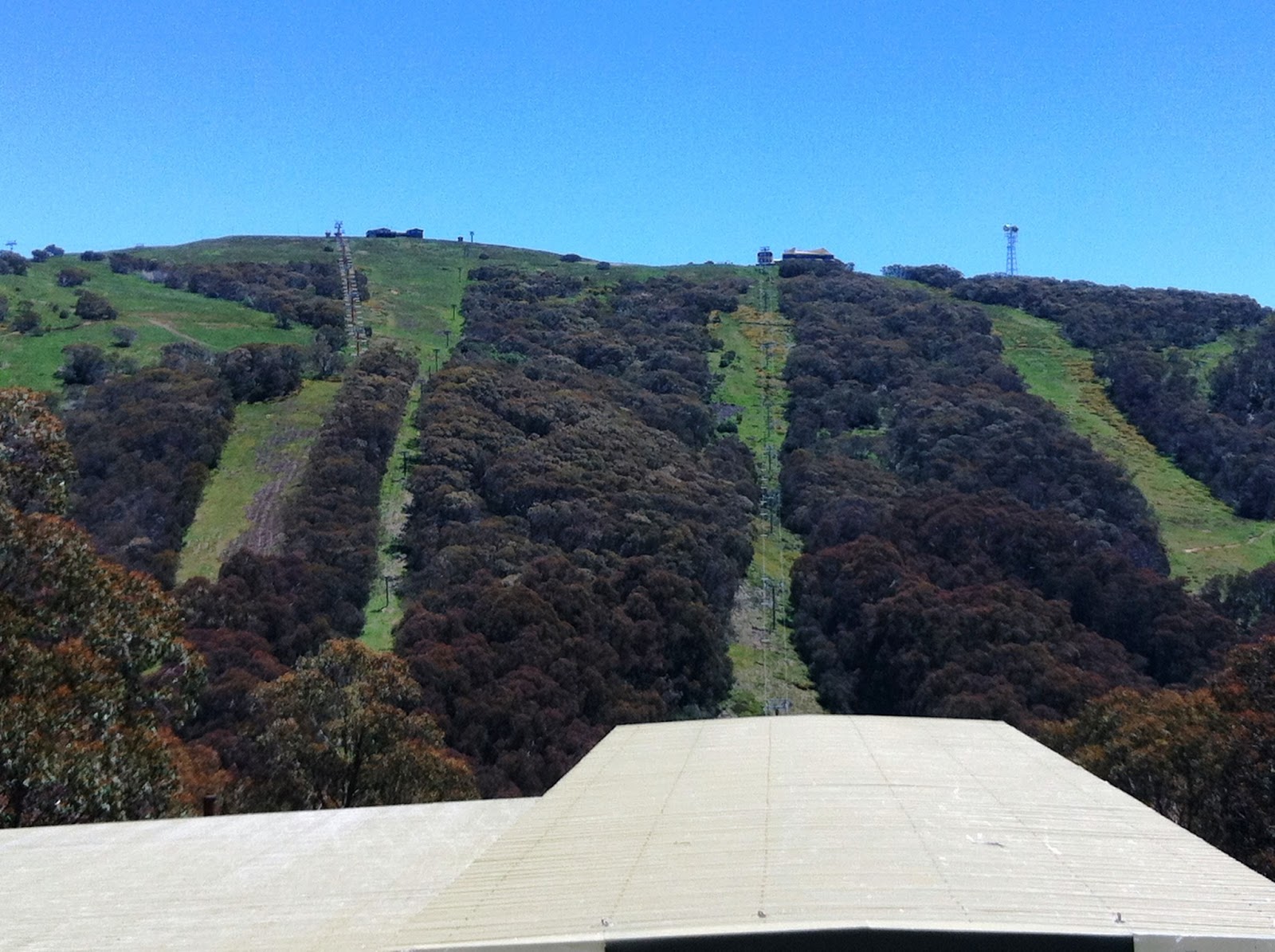
We were trying to escape the heat in the valley so my daughter and Adam suggested we go up to the top of Mount Buller. We agreed and it was about 8 to 10 degrees cooler as the temperature dropped from 38 to about 29 degrees. We stopped at the bottom of one of the newer quad chairlifts, divided into two groups of four each and hopped onto the lift to go up to the top, enjoy the view and have a drink. 


The view on the way up was wonderful as you can see from the pic above, we watched the mountain bikers sliding and twisting their way down the mountain bike paths and Adam gave us a running commentary of the scenery and the changes on the runs since he had gone on holidays. He pointed out where they had cleared the bush and where the forest was starting to creep into areas that would be cut back as soon as he returned to work. 

I listened with half an ear; the last time I rod a chair lift was about 10 years ago and it was about -5 degrees not +29degrees and I was enjoying the sun and the wind. I was also impressed by my two-year-old grandsons’ ease about riding the chair. He had been skiing a few months before and had ridden the chairlift with mom and dad so they could teach him to ski. 

I have video of him skiing and he appears to be enjoying himself and will take to the ski school in the southern winter with ease and enthusiasm. We need to be more open to experience and trust that we will enjoy and perhaps excel in them if we give ourselves half a chance.